

A reflection from a recent baptisand, by Kayleigh Gregg.
Christ is the revelation of what God’s love looks like when lived out in a human life: radical, embodied love.
He’s loving, merciful, gentle, truthful, compassionate, and present with us in our humanity. He meets me where I am and invites me toward wholeness.
Christ’s gentleness is the posture of someone whose power is fundamentally directed toward restoration.
He welcomes people.
He listens.
He touches the untouchable.
He eats with outsiders.
He forgives.
He heals.
He challenges hypocrisy.
He takes children seriously.
He notices people whom others overlook.
He calls people into transformation without first requiring them to become worthy of his attention.
How have I come to know him?
I’ve come to know him gradually over the decades of my life—through Scripture, prayer, contemplation, relationships, questions I’ve carried, and my own experiences.
I have been through some dark chapters. There have been times when things seemed hopeless, when I didn’t know what would happen next or what my life could become. And yet, even in those places, Jesus was there. And no matter what state he found me in, he has never looked at me and wished I were somebody else.
I sometimes wonder if I took that presence for granted because I waited so long to be baptized. I believed in him. I believed in his love. But I also grappled with Christian theology and struggled to reconcile a God of infinite love with theology centered on fear and exclusion.
So I began looking more closely at Jesus.
And the more closely I looked, the more I encountered a God whose love is vastly larger than the boundaries human beings draw around him. A God who is compassionate rather than cruel, who moves toward people rather than away from them, and who meets weakness with mercy.
A God who heals.
A God who bears burdens.
A God whose love isn’t threatened by human questions.
And then, through the hardships of my own life, I began to understand something more deeply: Jesus’s presence wasn’t simply an answer to the question of how I could survive difficult things. His presence began to show me what was possible for my life—and what might be possible for the world.
I began to realize that Jesus wasn’t simply showing me what God is like.
He was showing me what a human being can become when completely surrendered to love.
I keep finding myself moved by his way of being. When Christianity seems complicated, Jesus himself remains surprisingly simple:
Love God deeply.
Love people expansively.
Move toward suffering rather than away from it.
Make room for people who have been pushed outside.
Tell the truth with grace.
Lift burdens rather than adding to them.
Choose mercy over condemnation.
Over time, I realized that I wasn’t simply interested in Christianity as a system of belief. I was becoming interested in Jesus himself.
I have come to know Christ not because every theological question has been settled, but because Jesus keeps drawing me back:
toward mercy rather than judgment,
toward humility rather than superiority,
toward compassion rather than condemnation,
toward truth without cruelty,
toward love rather than fear.

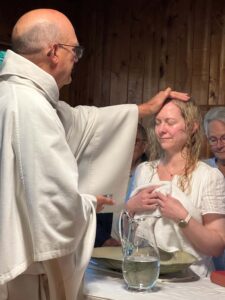
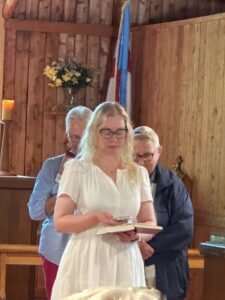
We invite you, too, to reflect on these beautiful questions Kayleigh asks in her reflection.
Who is Jesus to you? How have you come to know him? When and how have you encountered “a God whose love is vastly larger than the boundaries human beings draw around him”? How is Jesus showing you what God is like, and how do you find yourself moved by this way of being?