
Search Committee
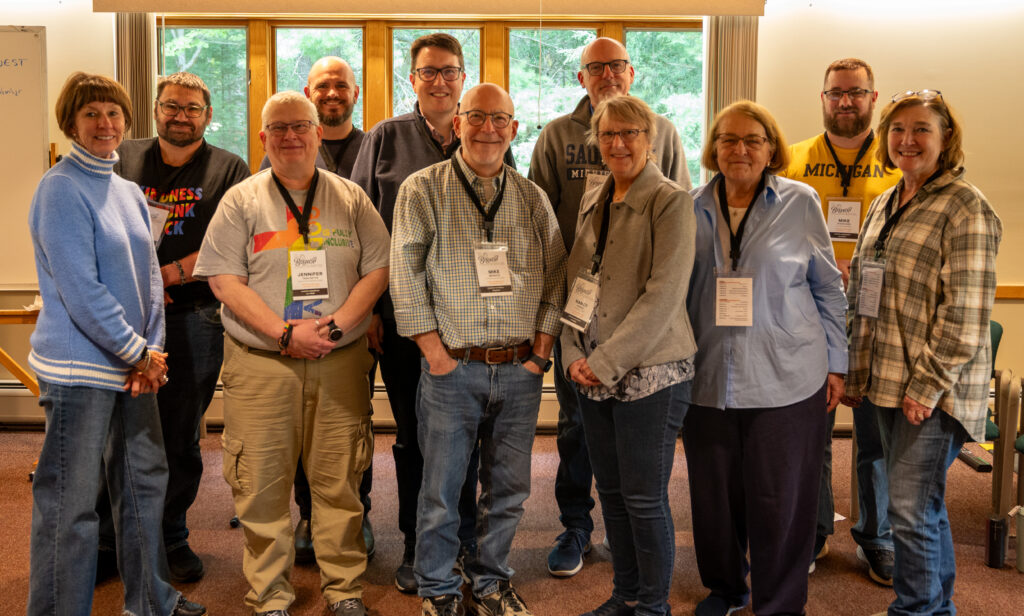
Search Committee Members
Jennifer Frechette, Co-chair
Deacon, Church of the Mediator Harbert
Michael Spencer, Co-chair
Priest, St. Thomas Battle Creek
Mike Wernick, Chaplain
Priest, Retired
Don DeWalt
Lay Person, St. Paul’s Elk Rapids
Beth Drew
Deacon, Trinity Three Rivers
Nancy Foster
Lay Person, St. Mary’s Cadillac
Mike Hueschen
Deacon, St. Luke’s Kalamazoo
Jay Johnson
Priest, All Saints’ Saugatuck
Elizabeth Jordan
Lay Person, St. Paul’s Flint
Betsy Lawrence
Lay Person, Emmanuel Petoskey
Dana Phillips
Lay Person, St. Paul’s Greenville
Matt Roney
Rector, Trinity Alpena
Search Committee Charge
The Standing Committee gave the following charge to the Bishop Search Committee:
The search committee is empowered to lead and shepherd the process of calling the first Bishop of the Episcopal Diocese of the Great Lakes through and inclusive of each step from being commissioned at its opening retreat to presenting a slate of candidates to the Standing Committee. Including but not limited to:
- Deciding how best and when to seek input and feedback from the diocese as a whole
- Drafting and publishing the profile
- Defining what materials will be required of applicants, accepting and reviewing applications
- Working with the consultant in conducting background and other checks
- Flexing actual dates/deadlines (e.g., for profile publishing, receiving names, etc. within the time allotted based on their discernment.
The Search Committee is empowered, safe, and supported to share back to the Standing Committee that the process isn’t working or has broken down. We follow the leading of the Holy Spirit, not dates on a calendar or the clock. We trust the Holy Spirit to bring the search committee to consensus when it is right. Declaring a “failed search” is a great act of faithfulness and courage, trusting in the work of the Holy Spirit among us.
To lead a holy and Spirit-led process:
- Pray and call all to pray. Pray within the Committee – not just to open meetings and not just about the search. Call the diocese to prayer. Write a prayer for our bishop-to-be.
- Listen and be still. Listen to and with the Holy Spirit. Listen to and with each other, making sure everyone shares and is heard and that meetings are balanced. Listen to and with the diocese, learning from data we already have and providing space and time for quick and slower feedback.
- Develop and deepen trust. With your committee, develop elastic trust, a way to dream big and come back, blue sky and actualize. Make and hold space to forgive each other and to not define people by disagreements. Throughout the diocese, contribute to growing trust in this time of turning over a new leaf, of growth. Remind people what it looks like to trust well, creating space instead of closing things down.
- Be empowered and empowering. The Standing Committee is passing this work to you with open hands believing that this is your job, your challenge, and your delight. Bring your full self to this work. You are called in the wholeness of yourself and who God has created you and led you to be. Extend gracious and ample invitations to all in the diocese to be heard and participate, emphasizing the value of individuals’ and entities’ input.
Search Committee Covenant
The Search Committee created this covenant to guide their interactions and decision making.
As members of the Search Committee for
the First Bishop of the Episcopal Diocese of the Great Lakes,
we seek to engage in our work together prayerfully,
and always mindful of the vows we have made
as part of our Baptismal Covenant.
♦
We strive to continue in the apostles’ teaching and in the prayers,
and to repent whenever we fall into sin; we commit in particular to:
- Prioritizing praying together in our committee work, including the value of shared silent prayer, attending as carefully as we can to the presence of the Holy Spirit among us.
- Appreciating the many aspects of a process of discernment, remembering that God intends to call faithful pastors and shepherds to the apostolic work of the episcopate.
- Realizing the seriousness of our shared endeavor while undertaking it not only with appropriate gravity but also with a “light heart,” foregrounding the Holy Spirit’s gift of joy as members of the Body of Christ.
- Recognizing our own fallibility and limitations, which will likely mean that each of us will at times fall short of our own ideals in the course of work, trusting that the Spirit will also provide forgiveness and reconciliation.
- Consulting regularly with our chaplain for spiritual insights and pastoral care.
♦
We strive as well to continue to proclaim the Gospel by word and example,
seeking Christ in all persons, and respecting the dignity of
every human being; we commit in particular to:
- Listening carefully to the other members of this committee, receiving gracefully the perspectives and opinions that might differ from our own, and valuing those moments as opportunities to learn something new, assuming positive intent from each person.
- Seeking voices and communities from around the whole diocese to help ensure, as far as it is possible, that we are accounting for the full range of experiences and locations in this diocese (especially congregations that may have been historically overlooked or undervalued for reasons of size or perspective).
- Creating a safe space—or at least a safer space than we might otherwise inhabit—for the sake of taking risks, being innovative, and engaging in a “faithful imagination” with each other for a future of thriving for our new diocese.
- Honoring the confidentiality of our proceedings and engagements with each other, including with potential candidates for the position of bishop, while also eschewing secrecy, knowing that this places a priority on timely and transparent communication with the diocese of actions taken by this committee.
- Embracing diversity as a gift of God and not a problem to manage by including in our shared communications with diocesan leadership and the wider diocese those matters, when appropriate, about which we do not fully agree, but on which we have nonetheless reached consent.
- Making decisions not only by majority vote, but by consensus, willing to relinquish personal preferences in favor of the wisdom of the group. We recognize that this approach might on occasion take more time for us as a group to reach a decision yet do so for the sake of a process that respects each person’s contribution and participation.
♦
Covenant agreements almost always stand in need
of practical and material guidelines for action;
we therefore actively seek methods and procedures
to help us live more fully into these covenantal agreements
For example:
- We agree to respect the group’s time by arriving to our meetings on time and ending our meetings on time.
- We agree to monitor our own behavior: to “step up” when we are usually reticent; and to “step back” if we have spoken frequently.
- We agree to a process of self-reflection and to trying to discern as clearly as we can our own motivations and histories that are shaping our participation in this work.
- We agree to honor both thoughts and feelings, our own and those of others, by saying what might feel tenuous and encouraging others when they have appeared brave.
- We agree to speak the truth to each other in love, including in those moments when some aspect of this Covenant Agreement has not been honored in a way we might have intended.